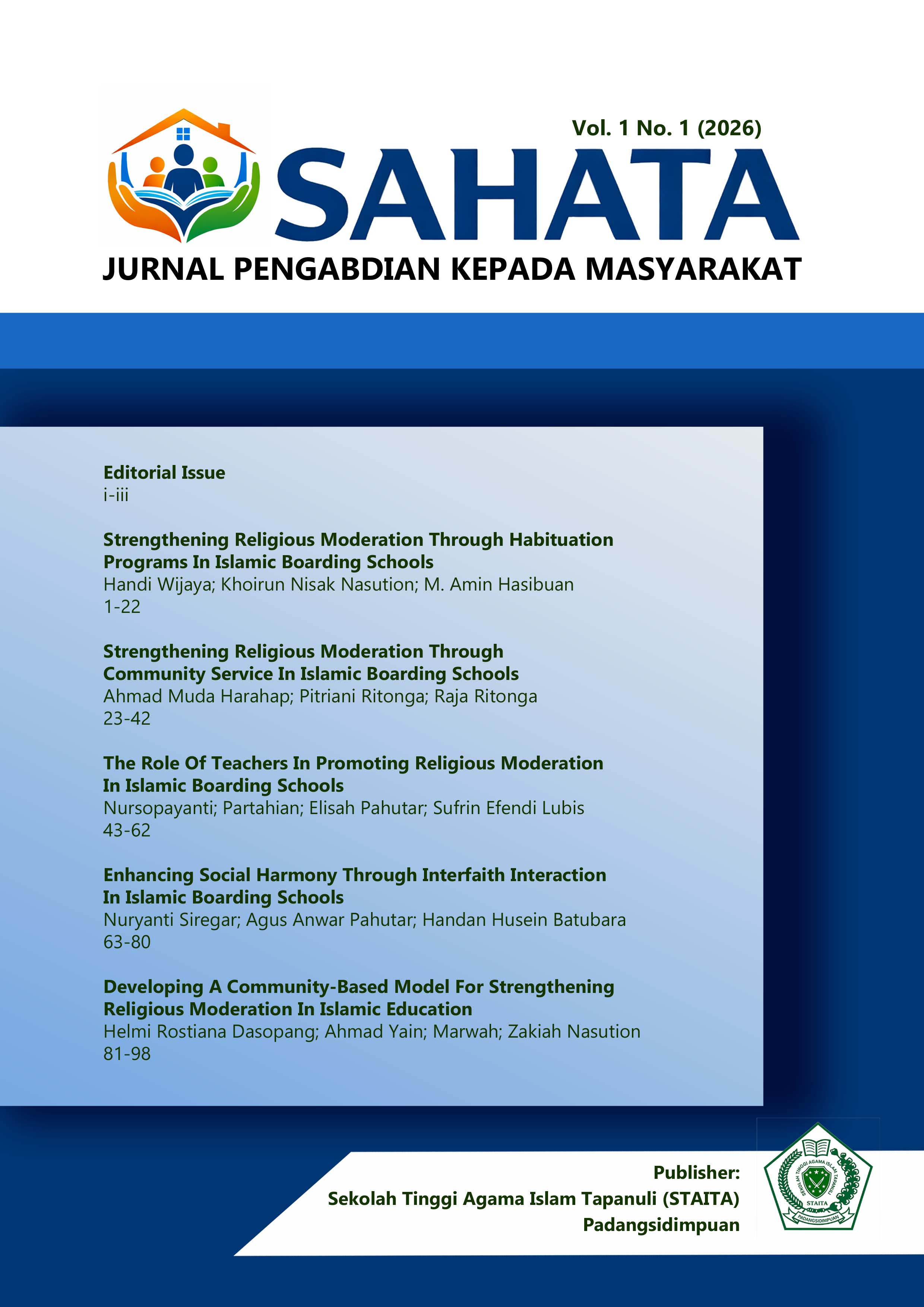
ENHANCING SOCIAL HARMONY THROUGH INTERFAITH INTERACTION IN ISLAMIC BOARDING SCHOOLS
الملخص
Interfaith interaction plays a significant role in fostering social harmony in pluralistic societies. In the context of Islamic boarding schools, engagement with diverse communities provides an important opportunity to develop tolerance and inclusive attitudes among students. This study aims to examine how interfaith interaction contributes to strengthening social harmony and religious moderation in Islamic boarding schools.
This study employed a qualitative approach within a community service framework, focusing on students’ interaction with communities of different religious backgrounds. The activities included social engagement, community-based interaction, and participation in shared social environments that encouraged dialogue and mutual understanding. The findings indicate that interfaith interaction significantly enhances students’ tolerance, empathy, and social awareness. Direct engagement with diverse communities enables students to reduce prejudice, develop mutual respect, and build inclusive perspectives. The results also show that continuous social interaction plays a crucial role in transforming abstract concepts of moderation into practical social behavior. This study concludes that interfaith interaction is an effective approach to promoting social harmony and religious moderation in Islamic educational settings. The findings provide practical implications for developing community-based programs that encourage dialogue, cooperation, and peaceful coexistence in diverse societies.
التنزيلات
منشور
النسخ
- 2026-04-11 (2)
- 2026-04-10 (1)
إصدار
القسم
الرخصة
الحقوق الفكرية (c) 2026 admin admin

هذا العمل مرخص بموجب Creative Commons Attribution 4.0 International License.
This journal provides immediate open access to its content on the principle that making research freely available to the public supports a greater global exchange of knowledge.
Authors who publish with this journal agree to the following terms:
1. Authors retain copyright and grant the journal the right of first publication.
2. The work is licensed under a Creative Commons Attribution 4.0 International License (CC BY 4.0), which permits unrestricted use, distribution, and reproduction in any medium, provided the original work is properly cited.
3. Authors are permitted to enter into separate, additional contractual arrangements for the non-exclusive distribution of the journal’s published version of the work.
4. Authors are encouraged to post their work online (e.g., in institutional repositories or on their website) prior to and during the submission process.
License details: https://creativecommons.org/licenses/by/4.0/