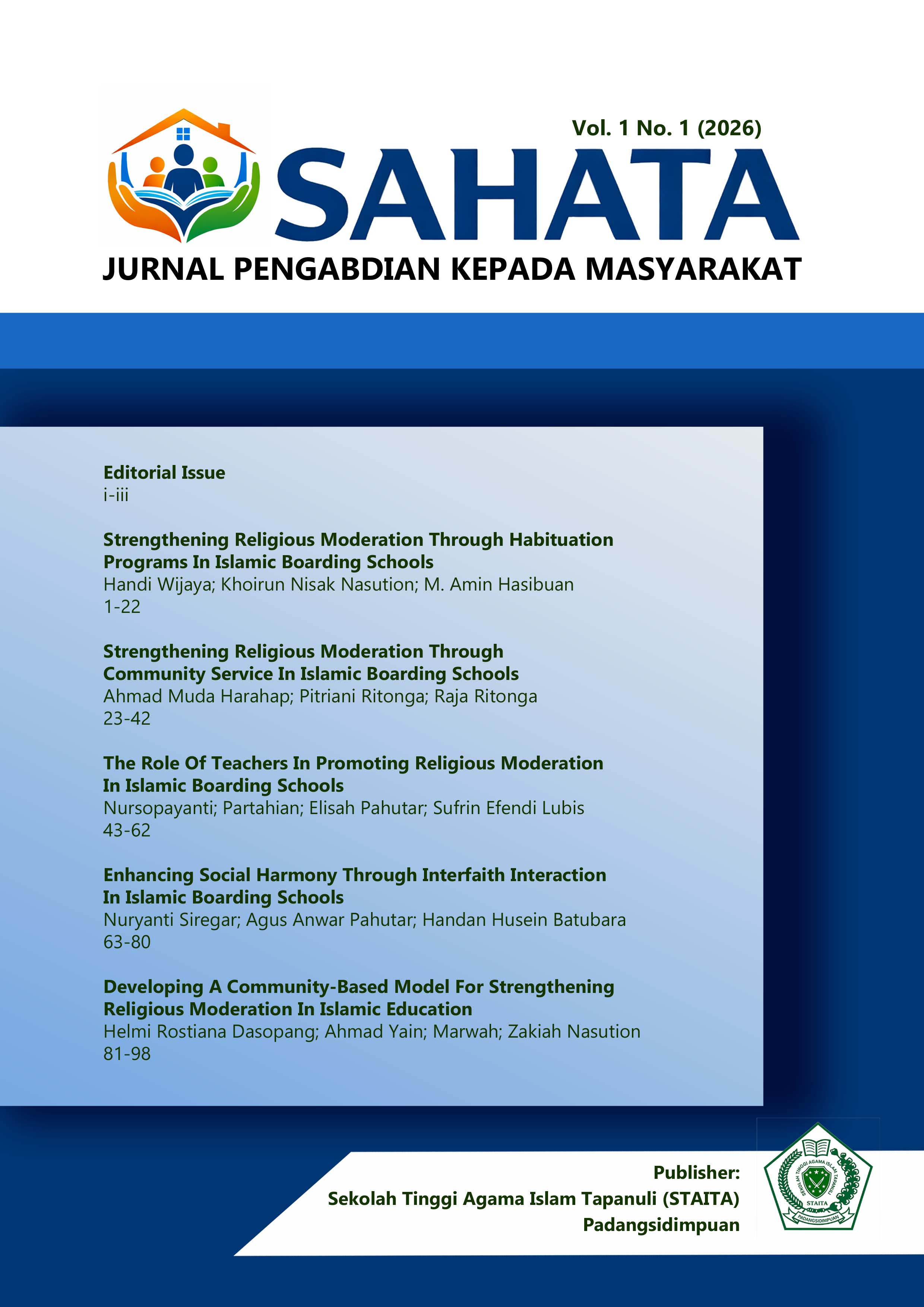
THE ROLE OF TEACHERS IN PROMOTING RELIGIOUS MODERATION IN ISLAMIC BOARDING SCHOOLS
Abstract
Teachers play a central role in shaping students’ character and attitudes, particularly in the context of religious moderation in Islamic education. This study aims to analyze the role of teachers in promoting religious moderation in Islamic boarding schools by examining their pedagogical practices, professional responsibilities, and ethical engagement with students. This study employed a qualitative approach within a community service framework, focusing on teachers’ involvement in mentoring, guiding, and modeling moderate behavior in daily educational activities. Teachers function not only as knowledge transmitters but also as role models who influence students’ attitudes through interaction, communication, and example. The findings indicate that teachers play a significant role in fostering religious moderation by integrating values of tolerance, balance, and inclusiveness into both formal and informal learning processes. Teachers’ professional competence, ethical awareness, and relational approach contribute to the development of students’ moderate and socially responsible behavior. This study concludes that teachers are key agents in promoting religious moderation in Islamic boarding schools. Their role extends beyond instruction to include moral guidance and character formation, making them essential in developing inclusive and balanced religious understanding among students.
Downloads
Published
Versions
- 2026-04-11 (2)
- 2026-04-10 (1)
Issue
Section
License
Copyright (c) 2026 admin admin

This work is licensed under a Creative Commons Attribution 4.0 International License.
This journal provides immediate open access to its content on the principle that making research freely available to the public supports a greater global exchange of knowledge.
Authors who publish with this journal agree to the following terms:
1. Authors retain copyright and grant the journal the right of first publication.
2. The work is licensed under a Creative Commons Attribution 4.0 International License (CC BY 4.0), which permits unrestricted use, distribution, and reproduction in any medium, provided the original work is properly cited.
3. Authors are permitted to enter into separate, additional contractual arrangements for the non-exclusive distribution of the journal’s published version of the work.
4. Authors are encouraged to post their work online (e.g., in institutional repositories or on their website) prior to and during the submission process.
License details: https://creativecommons.org/licenses/by/4.0/